 by Robert Plamondon
First published in Dragon Magazine #48, April, 1981.
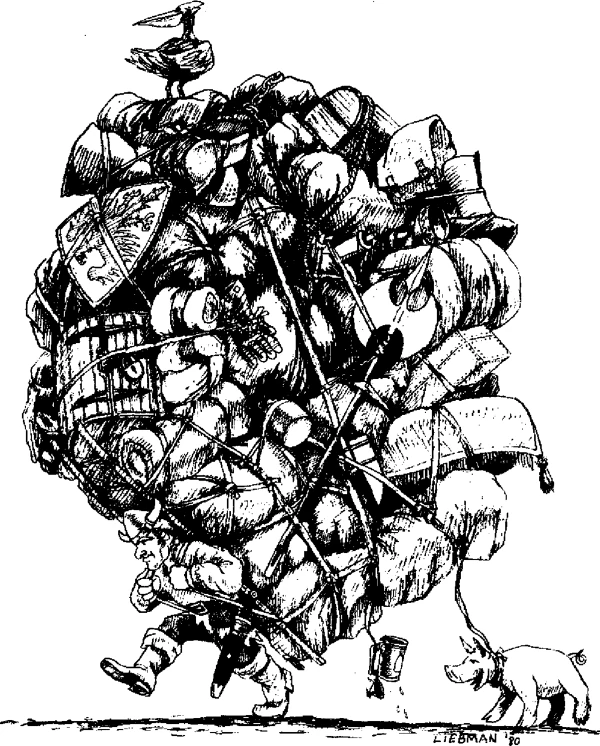
Many players of fantasy role-playing games have their characters take mules with them on adventures, hoping to fill their empty saddlebags with loot. Few players think of putting more than a few arrows and an extra bottle of wine on the mule for the trip in; mules are for the journey home.
This can be a fatal mistake, for a mule can carry an enormous amount of gear to keep the party going in unexpected circumstances. If you’ve ever run out of light and arrows in the same expedition, a well-laden mule (or donkey) is just what you need.
One method of arriving at the optimum assortment of gear for your faithful pack animal is to try everything, expecting to discard much of it on the way home if you find treasure. This is the method I used with my thief, Black Bart. But we still need to arrive at a more efficient system for sorting out the useful gear from the rest and avoid the reduced movement rate that comes from overloading.
What to Bring
Probably the most common type of equipment to load onto the mule is consumable goods; stuff that will be used up in the course of an adventure, such as food, torches, arrows, and beer. These are items that the characters probably don’t want to carry around themselves, at least not in large quantities, and since they gradually get used up the mule will have more and more room for treasure as the adventure progresses.
Another major category for dungeon gear is replacement items. Such things as lanterns and axes tend to get broken when used as makeshift Molotov cocktails and iron box openers, respectively. Items that tend to get broken or mangled on expeditions should have backups on the mule. This also applies to weapons in general (and bowstrings in particular if the rules are hard on them).
Special-purpose equipment can be important when you correctly predict what you need to take. This category includes all of those crazy things you think just might come in handy, such as rope and pulleys, mining tools, or a battering ram. In some dungeons these would be considered essential, while in others they would be worthless. Special-purpose equipment is usually selected after finding out the specifics about the area of the adventure, although Chaotics might decide to bring along all sorts of junk on spec.
Another important class of items, at least to low-level characters, is “repellents,” which include garlic, belladonna, wolfbane, mirrors, and holy water. Evil characters might add poison to the list. Repellents discourage certain opponents (wolfsbane disgusts were-creatures, while garlic and mirrors turn vampires off), or even kill them; for example, when a mirror reflects back a basilisk’s gaze or holy water destroys one of the undead. Belladonna is included as a repellant because it’s a sort of vaccine against lycanthropy, and because it doesn’t fit any of the other specific categories.
Note that holy water is quite a powerful weapon against the undead. Unless there is a powerful Cleric in your party, your only real chance to overcome the nastier undead creatures is to shower them with holy water. If you have a negative armor class and magic weapons you might try single combat with the next vampire that turns up, but when you get six levels drained off before you kill him I’ll be right there saying, “I told you so.” Any cretin can throw holy water, and vampires and the like are often much more vulnerable to half a dozen people splashing them than to a single fighter with a bright sword.
The last categories are tools, mule gear, and miscellaneous.
The tools you take depend a lot on the construction of the dungeon (or whatever) that you happen to be looting at the moment, and personal tastes and talents also affect selection. Everyday tools like hammers, chisels, pliers and files often come in handy, and many other tools can be useful in some circumstances. A small tool kit can save lives and gain treasure, since daggers and axes can’t always replace more specialized tools, especially in any delicate work you may have to perform.
Mule gear includes the mule’s bit and bridle, oats, saddlebags, and the mule itself. The saddlebags are important; a well-designed set of saddlebags is a lifesaver, while haphazardly throwing bundles and bags onto the mule will make finding items so difficult that the entire party could be eaten before the necessary object is found (DMs take note). One good system is to have a set of huge saddlebags custom made with a lot of large outside pockets, which are labelled as to what is inside. This way, someone who is unfamiliar with the layout of equipment in the packs will still be able to find things quickly. The least accessible compartments should hold things not normally used in melee, such as food and treasure.
The selection of a mule should be made with some care. Although many mules can be persuaded to go into dungeons, this does not mean that they will behave well while inside, Many mules will bray or run or both at the first sign of trouble, which is embarrassing and sometimes fatal to the party. Mules can be trained to accept a foul-smelling, dangerous underground setting by getting them accustomed to being in such places. Players can train mules in uninhabited caves and ruined fortifications, offending their sensibilities until the animals are used to odd smells, dank dungeons, and strange noises. All of this takes time—up to several months if you want a really good mule—but the players can hire someone else to do the job so that they remain free to go adventuring while the mule is being trained.
A more elegant (and more expensive) method is to get a local Druid to thoroughly charm a mule to its owner (a variant of Charm Mammal) and train it through an Animal Friendship spell.
Mules are semi-intelligent (Int of 2-4) and can learn three tricks per point of Intelligence. These tricks would typically include attacking on command, going where directed, standing quietly, and running (not “stampeding”) back to the surface. A good job on the part of the Druid will make the mule absolutely dependable in any situation that doesn’t involve magical fear or revulsion (such as from a lich or a ghast), but since the Druid needs to spend a week on teaching each trick, such training is expensive; DM’s should make sure players pay through the nose for such intensive work.
All of the goodies that don’t fit into the categories already mentioned get lumped together as Miscellaneous. Such items might include blankets, sacks, bribe money, etc.
Black Bart’s Cheat Sheet
Black Bart’s standard “mule sheet,” accompanying this article, has its items listed by category. Costs and weights are taken (when available) from the AD&D Basic Equipment and Supplies Cost table in the Players Handbook, and the Encumbrance of Standard Items table in the Dungeon Masters Guide. When an item was not listed, I guessed. In one case I disagreed with the Encumbrance Table; holy water is listed as weighing 25 gold pieces, or 2.5 pounds. This is too heavy for four ounces of water in a thin glass vial, so I used five GP per vial in the table.
The mule can only move at its full movement rate of 120 feet per turn if it’s hauling a weight of 2,000 GP or less. More gear will slow it down to half speed (60 feet per turn), which can cause you to lose all your treasure when the mule lags behind as you flee the dungeon with wolves at your heels. The mule can’t carry more than 6,000 GP under any circumstances
Donkeys can carry about half as much as a mule.
These limits make weight the most important criterion when deciding which useful items must be left behind. Bart’s gear weighs 1,976 GP, including the saddlebags, and costs 363 GP, 7 SP. With this load the mule can carry only 24 GP extra weight before slowing to half speed, but can haul 4,024 more before exceeding the maximum load for half speed. Bart is greedy, so his saddlebags are large enough to hold more than 4,024 GP in coin without throwing anything out.
| What Black Bart’s mule carries | |||
| (Cost and weight in gold pieces unless labeled otherwise) | |||
| Item | Qty. | Weight | Cost |
| Consumables | |||
| Arrows | 60 | 120 | 8 |
| Iron rations | 2 | 150 | 10 |
| Molotov cocktails | 10 | 200 | 20 |
| Oil flasks | 10 | 200 | 10 |
| Silver arrows | 10 | 20 | 10 |
| Slow match | 50 feet | 10 | 5sp |
| Torches | 10 | 250 | 1sp |
| Replacement Items | |||
| Bowstrings | 10 | 1 | 1 |
| Hooded lantern | 1 | 60 | 7 |
| Short bow | 1 | 50 | 15 |
| Repellents | |||
| Belladonna | 2 | 1 | 8 sp |
| Garlic cloves | 10 | 2 | 5sp |
| Holy water | 10 | 50 | 250 |
| Mirrors, sm. metal | 2 | 10 | 10 |
| Wolvesbane | 10 | 3 | 5 |
| Tools | |||
| Axe, firewood | 1 | 40 | 1 |
| Chisel, large | 1 | 10 | 10sp |
| File, large | 1 | 10 | 1 |
| Wedges, wooden | 30 | 60 | 0 |
| Mule Gear | |||
| Bit and bridle | 1 | 30 | 15sp |
| Meal, horse | 5 days | 100 | 10sp |
| Saddlebags, huge | 1 | 200 | 8 |
| Miscellaneous | |||
| Blankets | 2 | 60 | 1 |
| Rope | 150 feet | 225 | 12sp |
| Sacks, large | 5 | 100 | 8sp |
| Tinder boxes | 2 | 4 | 2 |
The dungeon Bart loots is small enough to make one-day expeditions practical, so it is something less than suicidal for him to not put any water on the mule (he carries a skinful in his pack, instead). If you tend to make camp underground, I would suggest taking two mules, the second carrying mostly food and water.
Weight considerations also kept Bart from putting those heavy iron spikes on the mule. He carries a dozen in a pouch anyway, so he puts wooden wedges on the mule for door-holding; they’re cheaper, lighter and quieter than iron spikes as doorstops.
It is important to not lose sight of the idea that the mule is used primarily as life insurance underground, and that the gear on the mule should be chosen to be helpful to the entire party, not just the mule’s owner. Even a Chaotic will recognize that letting other people put the stuff they’ll need on the mule will improve his life expectancy. Chaotics can cooperate too—if they remember to, and if you don’t expect too much from them.
Finally, the mule can carry out a couple of dead or badly injured characters, eliminating a major source of unsightly dungeon litter. The people who are saved through your mule’s assistance are often very grateful — especially if one of them happens to be you.