
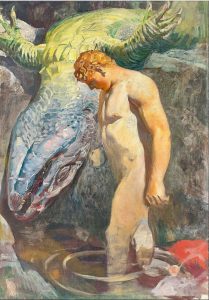
 by Robert Plamondon
First published in Dragon Magazine #41, September, 1980.
Siegfried, hero of Teutonic and Norse myth, slew the great dragon Fafnir and bathed in its blood. The dragon’s blood hardened his skin to the point that no weapon could pierce it—except where a linden leaf stuck between his shoulder blades during the bath and kept the blood away.
If skin hardening turned out to be a general property of dragon’s blood, new relief could be in sight for those many sufferers who feel naked and vulnerable in their flimsy +4 plate armor.
For my own campaign I have formulated some rules for gaining the benefits of dragon’s blood which are directly applicable to AD&D, and which will fit other fantasy role-playing games as well with modification.
The armor class benefit is determined at the rate of one step up in armor class for every ten dragon hit points, dropping all fractions. Successive applications (from different dragons) are cumulative up to armor class zero; the only way to beat AC 0 is to slay either Tiamat or Bahamut, giving armor classes of -2 and -6, respectively.
Armor may be used normally with toughened skin for increased protection. The formula for combined armor and armored skin is AC=AC of armor +AC of skin – 10. Thus, someone with AC 9 skin and AC 8 leather armor would have a total armor class of AC 7.
 There are, of course, some difficulties involved with skinnydipping in dragon’s blood. First off, the magical properties of dragon’s blood dissipate within an hour in any event. This, means that once the beast is safely dead, the attackers must frantically tear off their armor and clothes. A person in chainmail can probably fight his way out of his gear in a few minutes, but people in plate could use some help.
Next, the dragon has to be dead. The magical nature of the dragon is transferred to its blood only as it dies; siphoning three quarts from a live dragon gains you nothing.
The dragon must be slain with an edged weapon in order to open the wound that drains the lifeblood (arrows are edged weapons). No benefit can be gained from the lifeblood of a dragon killed in any other manner. Initial damage can be inflicted by any means except heat, cold, and electricity-based magic, which damage the lifeblood and ruin it for this purpose; but if the fatal blow is from something other than an edged weapon, forget it. Poison will, of course, poison the lifeblood, ruining it and killing the bather if he fails to save against poison.
Only a single person can gain the armor class benefit from a dragon’s lifeblood. If more than one person wallows in the dragon’s blood the Dungeon Master should determine who benefits (by rolling dice or by any other arbitrary method), perhaps with a chance that no one wins.
The protection of the dragon’s blood is permanent, and does not change the color or texture of the beneficiary’s skin; nor does it interfere with dexterity-related actions such as picking pockets or casting Illusionist spells. A Detect Magic spell will reveal that there is something magical about the person’s skin, but the nature of the magic is not obvious until divinatory spells are cast or someone sees the weapons bounce off someone else’s hide.
The toughening of the skin only protects against attacks that rely on skin breakage; thus, no help is gained against fireballs, but saving throws vs. poison needles would be improved; + 1 on saving throws for each + 1 on armor class from the dragon’s blood.
The DM may opt to give the bather a chance of missing a spot, leaving a small patch of AC 10 skin. The patch would be located where the bather couldn’t see it; on his back, neck, etc. No weapon would hit this spot in normal melee unless you normally use hit location tables; it’s too much trouble to keep track of. Assassination attempts, however, would have a good chance of succeeding if the assassin knew of the weak spot; this is how both Achilles and Siegfried died.