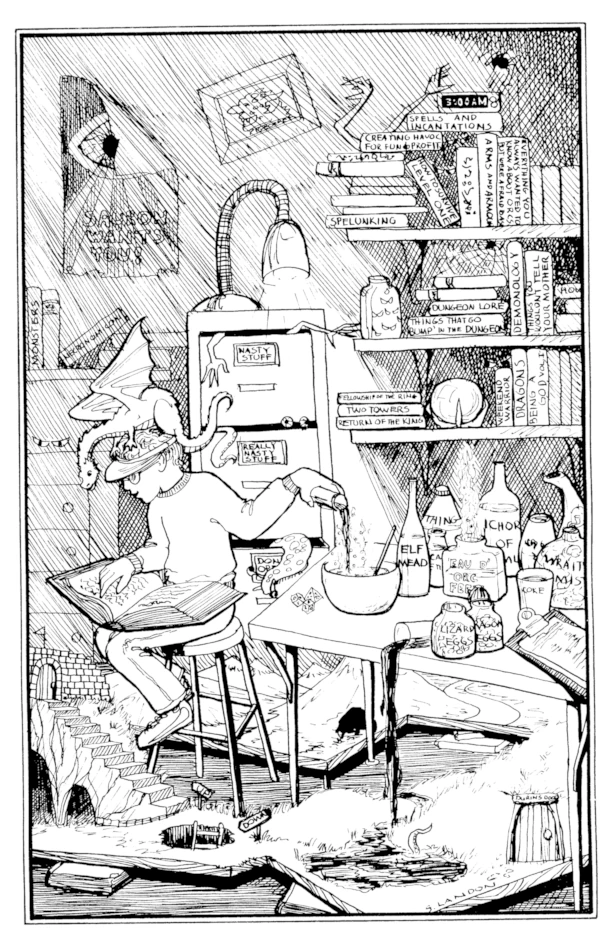
Chapters 1-2 of Through Dungeons Deep

Sample Chapters from “Through Dungeons Deep: A Fantasy Gamers’ Handbook” by Robert Plamondon Part I: How to Play Chapter 1: What Are Fantasy Role-Playing Games? Remember this from English Lit? As the men were sleeping, the monster burst into the hall. It seized a man, sank fangs into his throat, and drank blood until there … Read more

Give Them Enough Rope!

by Robert Plamondon

Originally published in Dragon Magazine #135, July, 1988.

What Can You Do With Fifty Feet of Rope?
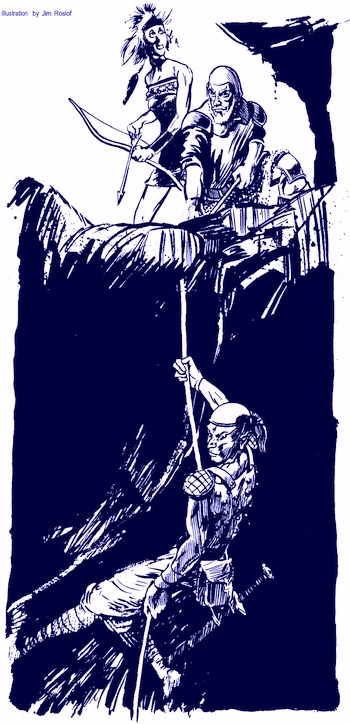
My characters have always used a lot of rope. They’ve used it to build bridges, lower people into chasms, climb mountains, hog-tie orcs, tether mules, and create traps. The creative uses of rope are nearly endless, but most game systems barely mention it. How much does it weigh? How much can it lift? Does it come in decorator colors?

Once, in a Chaosium RuneQuest® campaign that involved looking for a lost city in a big swamp, my character wanted to bring lots and lots of rope—about 1,000′ of it, in fact. RuneQuest gives the weight and breaking strength for rope (AD&D gives nothing but a price). According to the third-edition RuneQuest Gamemaster Book, a 30-meter rope that weighs 6 kg has a strength of 366 kg. Converting this to the D&D game’s standard 50′ rope, that would mean that a 50′ rope would weigh 6.7 lb. and be rated at 805 lb.

That sounds good, except that there are lots of different sizes of rope, and adventurers have uses for many of them. In addition, a quick look at a table of rope strengths would seem to contradict RuneQuest’s numbers. According to Mark’s Handbook,1 standard fiber rope sizes start at 3/16” and go up to 4”. The weight of a 50′ manila rope varies in that range from 12 ounces to 219 pounds! And the breaking strength. varies from 450 lb. to a whopping 105,000 lb. The size closest to RuneQuest’s weight of 6.7 lb. per 50′ is 11/16″ rope, which has a breaking strength of 4,400 lb.

Fiber rope is usually made out of plant fibers; hemp, jute, and manila are the most common. These ropes are cheap, strong, and relatively durable. The biggest problems with rope are rotting and simple wear.
Read more

Don’t Drink That Cocktail—Throw It!

by Robert Plamondon

This was my first-ever full-length paid article, in Dragon Magazine, Issue #40, August 1980.

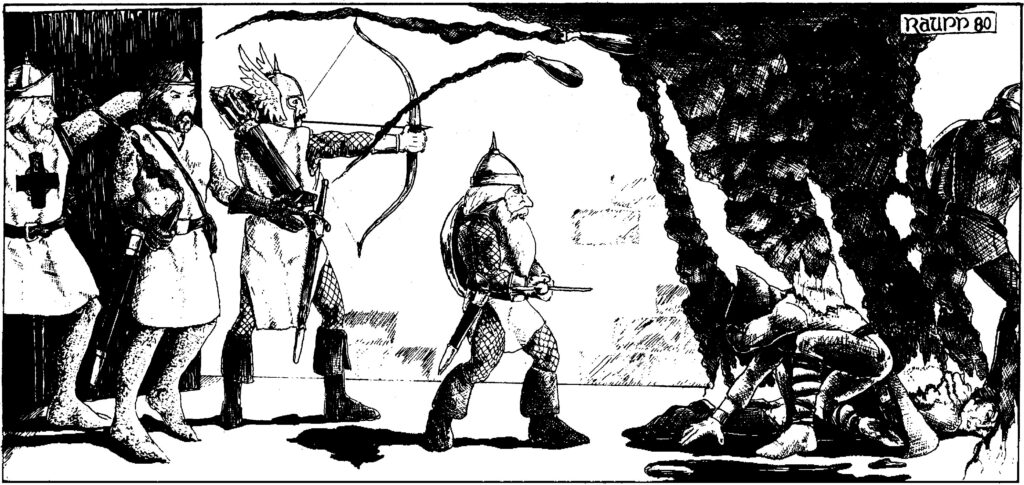
Festus the Dwarf kicks open the wide door of the bandits’ dun­geon home and throws in two molotov cocktails, burning one of the twelve bandits to death and wounding two more. Right behind come Rangers Smith and Jones and Cleric Lucretia, who each lob two smoking oil flasks. Before the bandits can react, over half receive serious bums and several are dead. The pools of flaming oil prevent them from regrouping. With sword and bow, the invaders pick off the survivors and take the room. None of the adventurers has taken a hit.

Many players, like those mentioned above, have realized that flaming oil is the most powerful weapon available to a low-level player in AD&D. A flask of oil burning on a monster (or player character) does 3-18 points of damage in the space of two rounds and can be used by all character classes except Monks. Compare this to a “paltry” 1-10 points of damage done by each hit of a two-handed sword.

Read more

My Magic Items from Dragon Magazine

When I and the world were young, my professional writing career got its start with a tiny piece in The Dragon, the D&D magazine from TSR Hobbies. This was my writeup of a humorous cursed magic item, The Rod of Singing, appearing in their Bazaar of the Bizarre column. They paid me money for it!

In the end, I sold them three magic items in 1980 and 1981, reproduced below. I went on to write many other articles and eventually a whole book, Through Dungeons Deep: A Fantasy Gamers’ Handbook (Reston Publishing, 1981, reprinted much later by me under my Norton Creek Press label).

Read more

Running a D&D Game for First-Time Players, Especially Kids

Playing Dungeons & Dragons and similar tabletop role-playing games for the first time is a bewildering but never-to-be-forgotten experience. Whether it’s also a good experience is up to you, the Game Master.
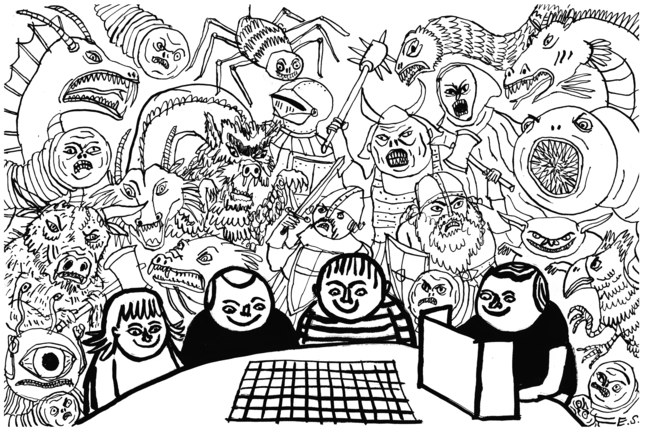
So how do we stack the odds in the beginner’s favor? I have some tricks.

Adding a Beginner to an Existing Group

When introducing a beginner into an existing gaming group, I give them a warrior character to play, one at least as high-level as the best fighter in the party.

Then I give them the pitch: “You’re playing a big, stupid, fearless, reckless warrior. You’re at least as powerful as any other warrior in the group. You get along with your friends and love destroying your enemies. With any luck, you’ll die a glorious death and save the lives of your friends by the end of the evening.”

Read more

Dungeons & Dragons Back in Fashion

The New Yorker published an article a while back, The Uncanny Resurrection of Dungeons & Dragons. Apparently even trendy people finally started playing role-playing games!
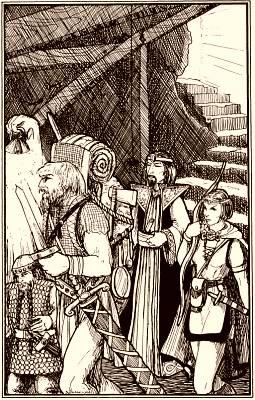
In the years after I wrote Through Dungeons Deep: A Fantasy Gamers’ Handbook, one thing that’s surprised me is how well the old-school role-playing games have held up, and how few important changes have been made in the newer editions. One thing that surprises me is that tabletop role-playing games are still done almost entirely by hand, with little in the way of apps to assist with the mechanics, dice, and table lookups. It’s still 1980 that way. But that’s okay. 1980 is a great vintage for role-playing games.

Read more

Ten Dungeon Mastering Tips for D&D and Other RPG Campaigns

dungeon mastering: the partyRobert Plamondon, author of Through Dungeons Deep: A Fantasy Gamers’ Handbook, shares ten DM’ing tips.

How can you make your role-playing campaign run more smoothly and be more fun for everyone? Here are ten quick dungeon mastering tips for any campaign:

1. Supply paper, pencils, and dice.

Counting on the players to provide even their most basic requirements doesn’t work, so don’t try. Always have more sharpened pencils available than players. Bring lots of paper. Have more dice than you can possibly use.

2. Enforce a “No touching” rule.

Some players can’t keep their hands off the other players. This is disgusting and must be stopped before the other players abandon your campaign just to get away from the offenders. Declare a “no touching” rule and enforce it. Come down hard on even minor infractions, or when the game gets exciting, the offenders won’t be able to control themselves and will be pawing and pummeling the other players like six-armed monkeys on acid. (“No touching” also includes “No pretending to touch, no brandishing, no looming over the other players.” They need to stay out of each other’s personal space.)

Read more

Through Dungeons Deep

A Fantasy Gamers’ Handbook

by Robert Plamondon

Reissued by Norton Creek Press. 340 pages. ISBN 9780972177078

  • Learn how to play old-school fantasy role-playing games
  • Learn how to be a Dungeon Master
  • Learn how to design your own fantasy campaigns
  • Tips and tricks for every occasion
  • An old-school renaissance/revival (OSR) guide from back when the old school was brand-new!

As new generations of gamers discover or rediscover the thrill of old-style role-playing games, this guide from D&D’s glory days is more valuable than ever.

Read more